Few factors shape agriculture as decisively as water. Whether in the form of rain, rivers, groundwater, or desalinated supplies, it is both a resource and a constraint, a driver of global trade and a limiter of local production. Today, as climate stress, soil salinity, and political trade tensions converge, water is emerging not only as agriculture’s most critical input but also as its most contested. And for farmers, water stress is no longer an occasional crisis but a structural challenge. The real question is not whether agriculture must adapt, but how fast – and with what tools.
In this issue of New AG International, we profile several stories from the sector that illustrate wheresolutions are emerging.
For instance, Elicit Plant’s phytosterol-based technology shows how targeted innovation can change the water equation. By enabling crops to reduce water use by 20 percent while delivering yield gains, the company demonstrates that efficiency is not simply about irrigation infrastructure – it can be designed into the plant itself. This is a powerful proposition for both rainfed and irrigated systems, offering farmers resilience in dryland agriculture and energy savings where irrigation pumps dominate operating costs. The speed with which Elicit Plant has moved from trials to global deployment is also
instructive: farmers are demanding pragmatic tools, not distant promises.
Meanwhile, advances in biostimulants signal a broader biological revolution. Once dismissed as “snake oil,” biostimulants are becoming precision tools. By activating plant defense mechanisms, strengthening roots, and improving nutrient uptake, they help crops withstand drought and heat stress. Companies like ICL Growing Solutions are leveraging artificial intelligence and metabolite libraries to accelerate product development. This convergence of biology and digital technology is shifting the paradigm – resilience is no longer a vague concept but a measurable, gene-level adaptation.
Water’s central role is also inspiring new forms of circularity. The partnership between GrowSolutions and Vitens in the Netherlands has created a fulvic acid biostimulant from the water purification process. Here, water infrastructure itself becomes a source of agricultural input, reducing reliance on resource-intensive extraction processes. Farmers gain a product that improves nutrient uptake and lowers pesticide use; water utilities gain a new revenue stream; and the cycle between water and food becomes tighter and more sustainable.
The export advantage – under threat The United States remains a world leader in irrigation equipment. In 2024, exports of pivots, pipes, and components exceeded half a billion dollars, with Canada and Mexico accounting for nearly half of all sales. This trade is not just about machines – it is about the promise of reliable water access for farmers in arid and semi-arid regions. But the
advantage is fragile. With tariff disputes simmering under the current administration, the threat of retaliation from Canada or Mexico could close critical markets.
The irony is sharp: at the very moment when global agriculture most needs tools to stretch every drop of water, political friction threatens to raise the cost of deploying them. Ensuring stable trade relations within the USMCA bloc is not simply a matter of industry profits – it is a matter of regional food security.
Even where irrigation infrastructure is secure, the water itself is changing. One-quarter of the world’s arable land is now impacted by salinity. In California, Arizona, Australia, and across Central Asia, growers are already forced to irrigate with marginal or saline water. Without innovation, this trend will squeeze yields, degrade soils, and leave farmers with fewer options.
Yet here too, science is pushing the boundaries. USDA researchers have bred alfalfa lines capable of surviving on seawater. Australian teams are testing drip irrigation with moderately saline water on tomatoes and melons, with promising results. Geneticists are identifying salt-tolerance genes in apples, spinach, and even wild halophytes, with the potential to engineer them into mainstream crops. Meanwhile, international centers are promoting quinoa and other salt-loving species that thrive where wheat and rice fail.
The picture that emerges is not one of despair, but of adaptation – plants, systems, and farmers reconfiguring to live with the water they have, not the water they wish they had.
Elsewhere, companies like Éléphant Vert are demonstrating that water management begins below ground.
Healthy soils act as living sponges, capturing rainfall and irrigation, slowing runoff, and holding moisture where plants can reach it. When organic matter is built up through amendments and regenerative practices, humus alone can retain up to 15 times its weight in water.
Éléphant Vert’s biosolutions – from organic fertilizers to microbial inoculants such as Pseudomonas putida I-4613 – work on two fronts: increasing the water-holding capacity of soils and improving the resilience of crops themselves. By stimulating root growth, activating anti-stress enzymes, and strengthening plant defenses, these products enable crops to withstand longer dry spells without compromising yield. The principle is clear: the best irrigation system is wasted on degraded soils that cannot hold water.
But biology and soil health alone cannot close the gap. New technologies are also needed to maximize the efficiency of irrigation itself. Engage Crop Solutions’ Aqualatus represents one such breakthrough. This biodegradable liquid formulation, now in use from Spain to Morocco, reduces water loss from evaporation, runoff, and leaching by as much as 50 percent, locking moisture in the root zone.
For farmers, the benefits extend beyond water. Reduced irrigation means lower pumping costs, less fertilizer loss, and ultimately higher margins – an especially critical factor as energy and input costs surge worldwide. With trials in 17 countries and adoption already spreading across North Africa and the Middle East, Aqualatus shows how innovation can be both agronomically effective and commercially scalable.
The common thread between Éléphant Vert’s biological approach and Engage’s irrigation technology is not competition, but complementarity. Healthy soils make irrigation more effective. Smarter irrigation ensures soil biology can function. Together, they illustrate the dual path agriculture must follow: build resilience into the plant–soil system while deploying technologies that optimize water delivery and retention.
In the decades ahead, agricultural performance will be judged less by tonnes per hectare and more by litres per tonne. Farmers who can produce more with less water will have the competitive edge. Nations that secure sustainable water strategies will safeguard their food systems.
And neither trade policy nor crop breeding can be seen in isolation. If tariffs limit access to irrigation equipment, farmers lose time and options. If breeding programs stall, salinity will continue to take land out of production. Water as an agricultural resource is not just about infrastructure or genetics; it is about integrating both to keep food systems viable.
For policymakers, the lesson is blunt: water must be treated as a strategic agricultural resource, no less important than oil or fertilizer. Trade agreements should safeguard the circulation of irrigation technologies. Research budgets should prioritize water efficiency and salinity tolerance. And public–private partnerships should accelerate deployment, not just discovery.
The world is learning, sometimes the hard way, that the most decisive battles in farming are not fought with seed or soil – but with water. ●
We hope you enjoy this issueof New AG International.
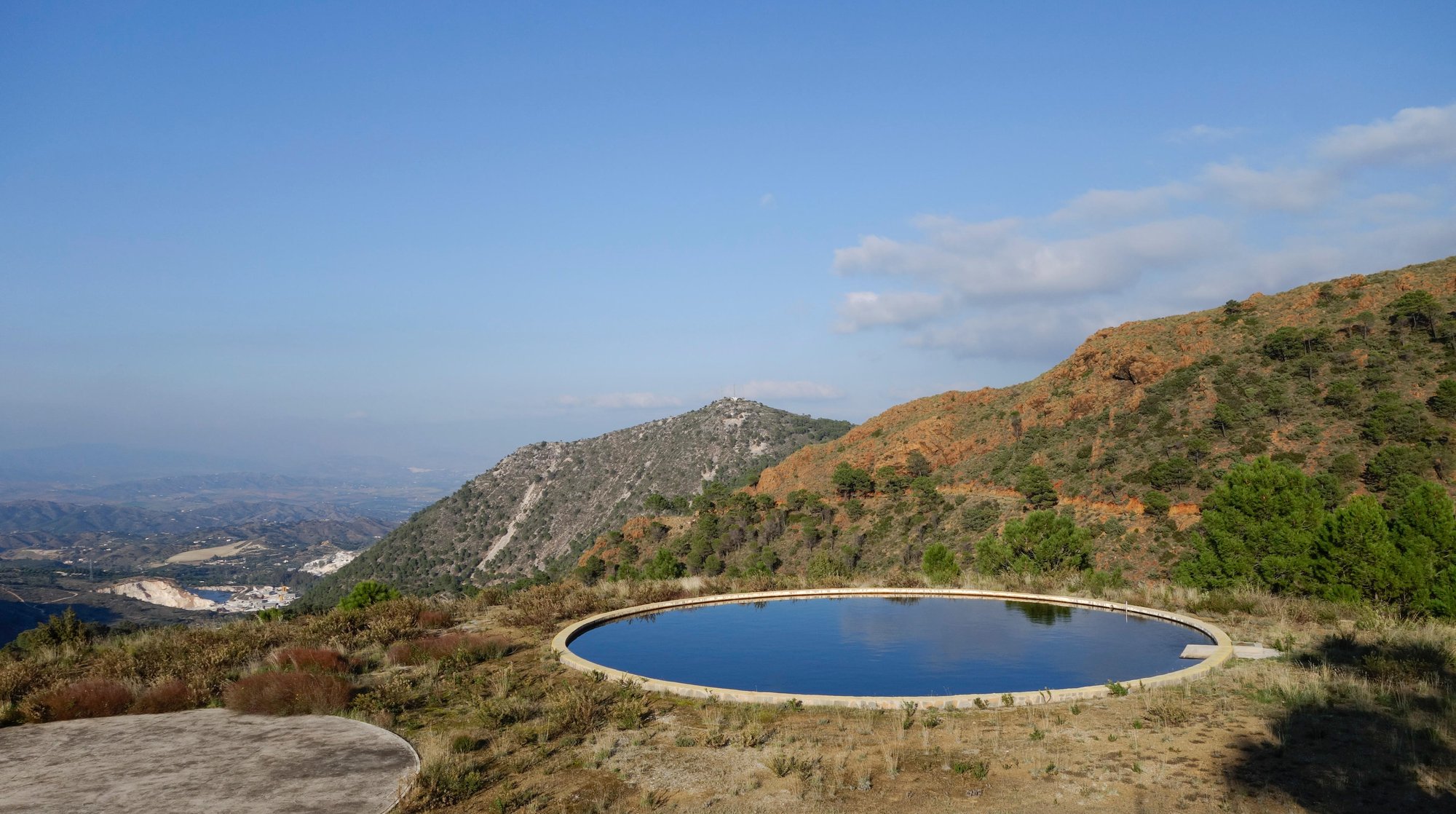
Water deposit tank, reservoir, in mountainsfor the irrigationof farmland Malaga province, Spain
Perry van Munster/Alamy